We are delighted to annouce that our founder, Peter Vogel, has been invited to the World Entrepreneurship Forum 2012 which will take place from October 24-27 at EM Lyon. The World Entrepreneurship Forum is a global community of entrepreneurs, social entrepreneurs, experts and politicians who aims at shaping the world of 2050 with an entrepreneurial vision, creating wealth and social justice. The World Entrepreneurship Forum is a selected community of entrepreneurial actors chosen for their entrepreneurial achievements and their commitment to society. Founded in 2008 by EM LYON Business School and KPMG, joined in 2011 by ACE (Action Community for Entrepreneurship, Singapore), NTU (Nanyang Technological University, Singapore), Ville de Lyon, the chamber of Commerce of Lyon and Zhejiang University, the Forum aims at finding entrepreneurial solutions to our world’s problems. It promotes the entrepreneurial spirit in all fields of society and encourages all forms of entrepreneurship, integrating economic and social objectives.

As we had been writing in some of our latest postings, the economic recession has not only decreased the quantity but also the quality of jobs. The 190 million unemployed (of which a significant portion are youth), as well as the 500 million job seekers over the next 10 years, will fully depend on the labor market in order to create sufficient wealth and social stability. Economic and political action is required to create gainful employment in order to ensure this social cohesion and stability. One of the 7 goals of Rio +20 is to create awareness of the necessity to create decent jobs. However, they do not just talk about any kind of job, but in particular about "Green Jobs" which include positions in agriculture, industry, services and administration that contribute to preserving or restoring the quality of the environment. A widely quoted UNEP/ILO green jobs report [1] suggested that the number of green jobs in the world might increase from 2.3 to 20 million from 2006 to 2030, which implies creation of 750,000 green jobs per year (59% in biofuels, 31% in solar PV). China alone would have 4.5 million jobs in wind and solar power by 2020. Yet, where is the trend going and how far are we from reaching the MDG 1B which states "full and productive employment and decent work for all, including women and young people"? According to various reports we are too far away. "Exacerbated by the global financial crises, labour markets have recently deteriorated, more workers have been forced into vulnerable employment, and more workers find themselves and their families living in extreme poverty." [2]. Let's hope that policymakers start acting more like entrepreneurs who have to survive in a fierce and competitive global market, thus taking risks and taking responsibility for their actions. The investment they have to make in the future is clear. Now they only need to fulfill their bloated promises. We at The Entrepreneurs' Ship will try to do our best at supporting the aspiring young people in areas with high unemployment rates in realizing entrepreneurial projects, thus creating jobs for themselves and others; to become a part of the solution to their own problem... Read more details about Rio +20 and their seven goals on their website. 1: UNEP and ILO (2008). "Green jobs: towards decent work in a sustainable, low‐carbon world." 2: Rio 2012 Issues Briefs No 7: "Green Jobs and Social Inclusion"
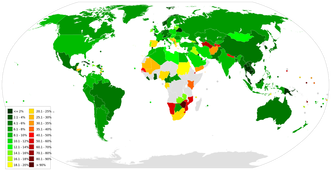
Governments all around the world face critical challenges to reduce unemployment and poverty (see world map of unemployment distribution below) (Guillén 2001). According to the ILO, the number of working poor—those unable to earn enough to lift themselves and their families above the US$2/day poverty line threshold per person—may constitute 45 percent of the worlds’ employed. The worst-case scenario shows 53 percent of the employed population in vulnerable employment. Further deterioration in the global economy may push as many as 200 million workers, mostly in developing economies, into extreme poverty—below the $1.25/day poverty line threshold. The United Nations Millennium Development Goals have set clear targets saying that
> The proportion of the population whose income is less than $1 must be halved > Full and productive employment and decent work must be achieved by all
The past years have caused an economic and labor market crisis which plagued the world since 2008. The labor market slowdown is dramatic with a current deficit of around 50 million jobs in comparison to the pre-crisis situation (ILO 2012). The crisis has paralyzed enterprises and forced millions of people into unemployment. Since the economic crisis, more workers have been finding themselves and their families living in extreme poverty, partly due to the vulnerable employment relationships or even unemployment. In addition, the lack of opportunities for decent work disproportionately affects youth and women.
The International Year of Youth (2010/2011) comes at a time when global youth unemployment rate is at an all-time high. According to a recent report published by the International Labor Organization (ILO), of the 620 million economically active youth between the ages of 15 and 24, 81 million were out of work at the end of 2009. There was a noticeable increase of over 2% from the 2007 figures of 11.9%, therefore making this the highest rate ever. With economies worldwide still recovering from the recent 3 year economic slump, the ILO predicts there will be huge numbers of unemployed youths adding to this number (ILO 2010).
Developing countries account for almost 90% of the world’s youths. The ramifications of high numbers of youth unemployment are much worse than in developed countries, with a serious threat of social disruption. Individually, figures of youth population may more than double by 2050 according to Carl Haub, senior demographer at the Population Reference Bureau (PRB). “Young people are the drivers of economic development […] Forgoing this potential is an economic waste and can undermine social stability” stressed Mr. Juan Somavia, ILO’s General Director. Far from being the drivers of economic development, nevertheless, in the case of development processes for most developing nations, these youths are undoubtedly the building blocks of the future. Youth unemployment rates do not have to end in a catastrophe for those generations labeled the Millenials (Generation Y: 1982-1990) and the Internet Generation (Generation Z: 1991 – present) and those it sustains. They might actually benefit from the situation if policymakers can incentivize and support them to follow their dreams. There are already significant numbers of young people who would rather start their own business instead of working for someone else. However, governments around the world are not yet ready to regulate and sustain this trend in the labor market. Entrepreneurship is an important driver of economic prosperity and social well-being, creating jobs and economic competitiveness (Monitor Company Group 2009). In 2003, SMEs accounted for roughly 66% of employment within the EU (34% from micro enterprises with less than 10 employees) (Eurostat 2010). Evidence suggests that the entrepreneurial intentions and founding rates among the unemployed are high and the survival rates of their firms impressive. For instance, formerly unemployed founders are responsible for 62% of new firms created in Germany, 30 % in Sweden, and 15 % in Austria (SCB 1994; Institut für Mittelstandsforschung 2005). Firms created by the unemployed even seem to have slightly higher survival chances than other types of new firms (Brüderl, Preisendörfer and Ziegler 1992).
While many countries have initiated programs to tackle the above-mentioned problems on the labor market, few countries have true control of the situation. Entrepreneurship programs are on the uprise and governments as well as schools and universities see an increasing importance of entrepreneurship in helping establish and maintain tomorrow’s jobs. One approach that has proven to be successful in Western countries is policy programs to help transition unemployed individuals into self-employment. Various countries have set up similar policy solutions with comparable features such as financial assistance in the form of a government stipend equivalent to the unemployment, tax incentives, coaching and training (Benus, Johnson, Wood et al. 1994; OECD 1995; Blanchflower and Street 2004)
While entrepreneurs are the ones that implement change, they alone cannot be held responsible for creating the next steps in societal evolution and the development of tomorrow’s jobs. There are many varied factors that influence entrepreneurship, ranging from economic and political to socio-cultural ones. Therefore, when discussing entrepreneurs as the agents of change, it is at least as important to discuss the environment in which they want to, or have to, create these changes. What changes have to take place on a political level to foster entrepreneurship and promote entrepreneurially-minded people in their endeavors?
On Sunday, April 29th, the International Labor Organization (ILO) has published the World of Work Report 2012. The results are everything but promising. In 2012, more than 202 million people are expected to be unemployed with numbers rising on a daily basis. This is still a result of the 2008 crisis with governmental austerity being at the heart of the resulting unemployment rates. Women and youth are disproportionately affected by unemployment. In particular, youth unemployment rates have reached exorbitant nuhmbers. Young people are three times more likely to be unemployed and over 75 million youth worldwide are looking for work. These rising numbers of unemployment, in particular for the younger generations, will result in long-term “scarring” of the social structures and in particular these upcoming generations (millenials and internet generations), if governments do not react quickly to find countermeasures. Entrepreneurship as a viable career opportunity must be further emphasized. We must help the younger generation help themselves get out of this without having to sit aside waiting for others to pull them out of the quicksand. However, time is running and it might not be long until it is too late for such measures. The entrepreneurial bootcamps, workshops and mentoring programs created by The Entrepreneurs' Ship are tailored to the needs of youth in emerging markets and developing countries with the aim to create innovation, jobs and social stability. Read the full ILO Report here
| | More than 90% of companies launched by unemployed individuals are still viable after three years. And they’ve also created additional jobs, potentially bringing even more people out of unemployment. This phenomenon has been studied at EPFL in order to better understand how companies are formed.
| Interview with our Academic Advisor, Prof. Dr. Marc Gruber, on our research project on Entrepreneurship by formerly unemployed individuals in Switzerland, Germany, France and Belgium. Read the full interview here.
|